AI, reproducibility, and integrity
Research Skills — Week 9
Recap
Recap
- What AI does well — and badly
- AI audit
- Reproducibility
- Reproducibility check
- Scientific integrity
- Open discussion
- Wrap-up
Where we are
Your projects are nearly done. You’ve designed investigations, run tests, fitted models, and identified limitations.
This week: two forces that shape modern research —
AI and the pressure to produce results.
Questions?
Submit questions:
PollEv.com/geol
text geol to 07480 781235
What AI does well — and badly
- Recap
What AI does well — and badly
🎓💬 Concept block 1
- AI audit
- Reproducibility
- Reproducibility check
- Scientific integrity
- Open discussion
- Wrap-up
AI is good at…
- Generating first-draft code
- Summarizing text
- Suggesting structure
- Spotting syntax errors
- Explaining error messages
AI is bad at…
- Knowing whether its answer is correct
- Understanding your specific data
- Making judgement calls about methodology
- Citing sources reliably
- Distinguishing meaningful from spurious results
Live demo (if possible)
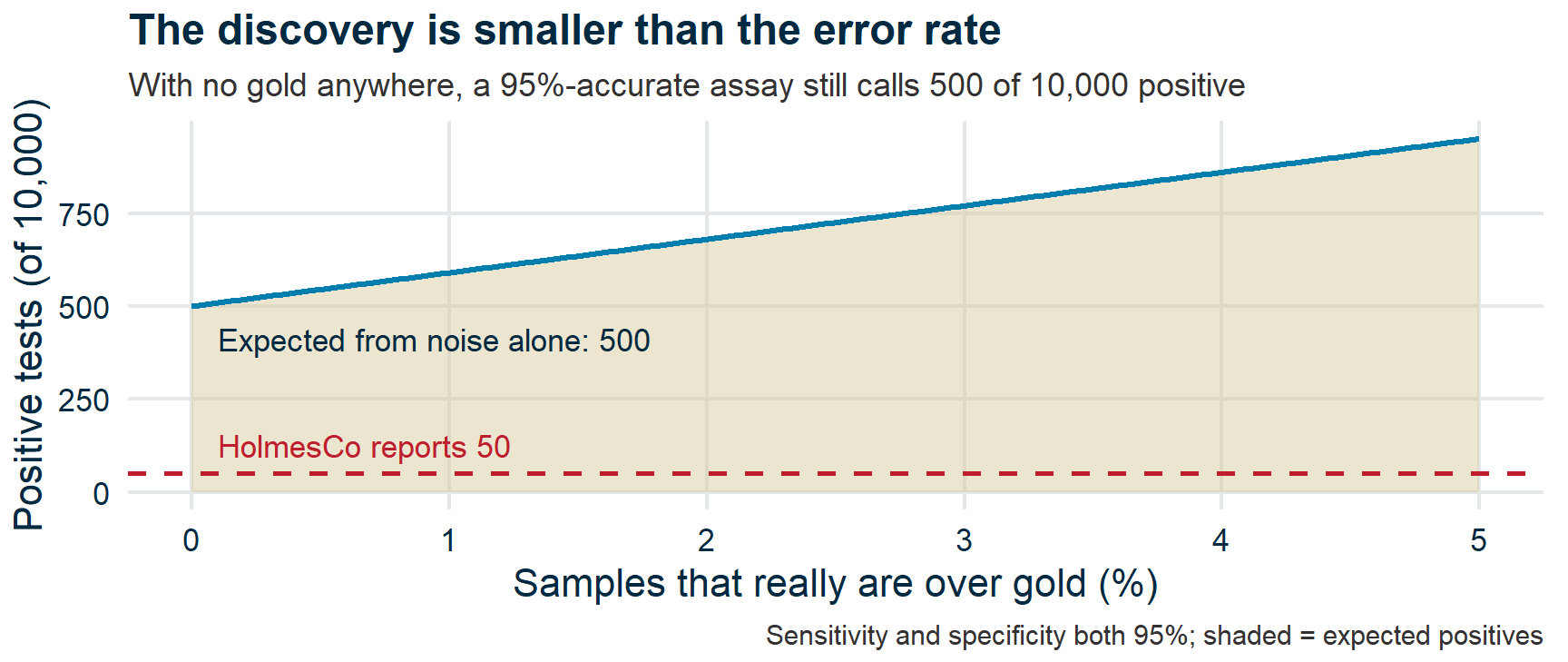
🖥️ Give an AI the HolmesCo gold assay scenario
“We tested 10,000 soil samples with a 95%-accurate assay. 50 tested positive. What’s the probability of a true gold deposit?”
Watch what it does with the base rate.
The discovery is smaller than the error rate
The key distinction
AI is fluent but not thoughtful.
It can write a convincing paragraph about any result — including a wrong one.
AI audit
- Recap
- What AI does well — and badly
AI audit
💬 Exercise 1
- Reproducibility
- Reproducibility check
- Scientific integrity
- Open discussion
- Wrap-up
Your experience
Think about a time in this module when you used AI (or were tempted to). What did it help with? Where did you have to override it?
Common patterns:
- Useful: debugging code, plot templates, explaining errors
- Unreliable: interpreting results, choosing methods
Reproducibility
- Recap
- What AI does well — and badly
- AI audit
Reproducibility
🎓 Concept block 2
- Reproducibility check
- Scientific integrity
- Open discussion
- Wrap-up
The replication crisis
Many published findings don’t hold up when others try to reproduce them.
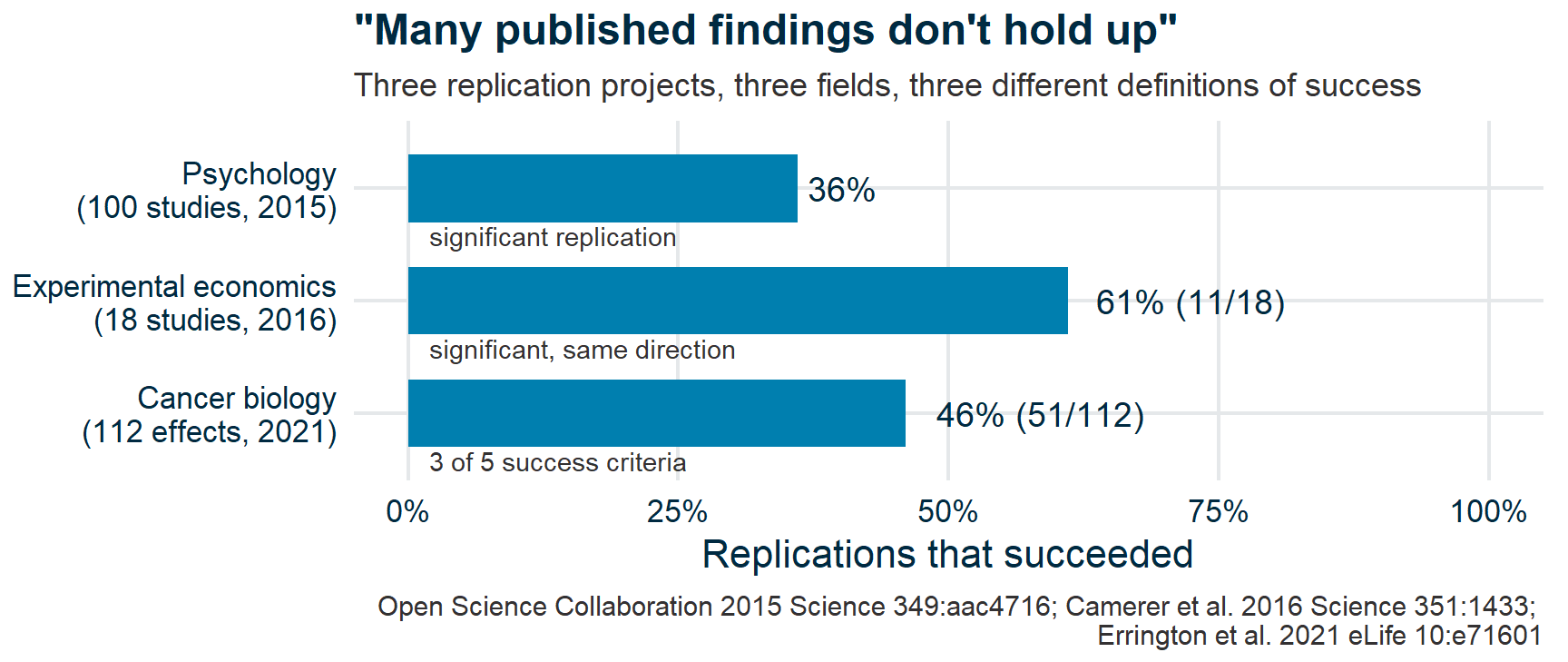
Why?
- p-hacking — trying many analyses, reporting the one that “works”
- Underpowered studies — too few observations to detect real effects
- Selective reporting — filing away null results
- Data not shared — no one can check your work
Your commit history IS your reproducibility record
If someone cloned your repo and ran your code, would they get the same results?
One number, or the shape it came from
A bootstrap interval — like the one you’ll build this afternoon in exercise w9_1, from uk_electricity.csv — is not a fact about the world. It is a range read off a distribution of 1,000 resampled means.
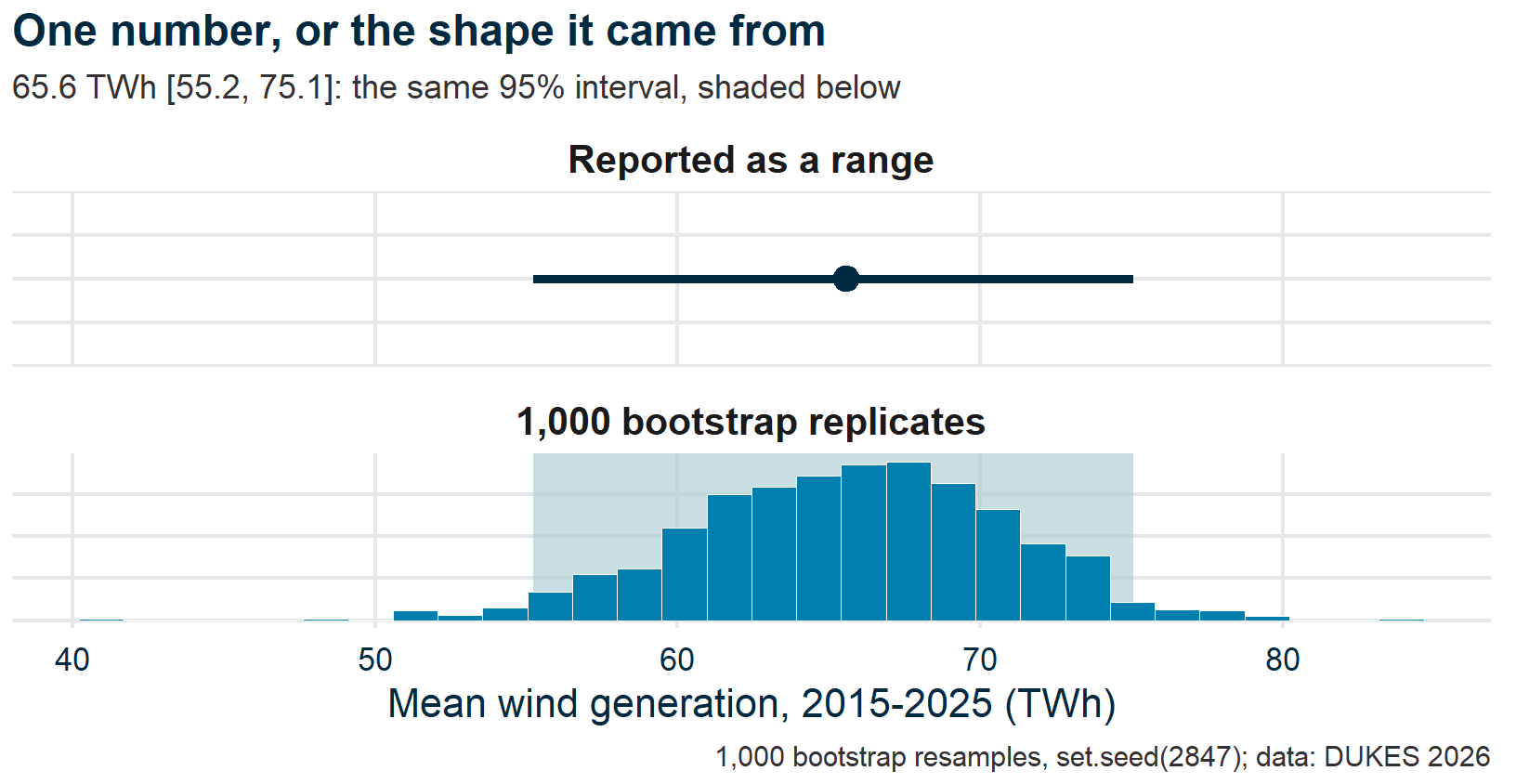
Rerun it without the seed
This afternoon’s bootstrap draws random resamples. Run the same code twice with no set.seed() and the 95% interval moves both times:
| Run | 95% interval (TWh) |
|---|---|
| No seed, run 1 | 55.8 to 74.8 |
| No seed, run 2 | 55.7 to 76.1 |
set.seed(2847), any run |
55.2 to 75.1, always |
Which of these three rows would you want printed in your report?
Practical reproducibility habits
- Script everything — no “I typed this in the console”
- Document your decisions — why this test, why you excluded those data points
- Record software versions —
sessionInfo()in R - Seed anything random —
set.seed()beforesample()orreplicate(), once, not inside the loop - Share data and code — within ethical limits
Reproducibility check
- Recap
- What AI does well — and badly
- AI audit
- Reproducibility
Reproducibility check
💬✏️ Exercise 2
- Scientific integrity
- Open discussion
- Wrap-up
Can you re-run your analysis?
Open your project repo. Start a fresh R session.
Run your analysis script from scratch.
Does it work? What breaks?
Common problems:
- Hardcoded file paths
- Missing libraries
- Steps done in the console but not saved
Fix what you can. 10 minutes.
Attendance
Scientific integrity
- Recap
- What AI does well — and badly
- AI audit
- Reproducibility
- Reproducibility check
Scientific integrity
🎓💬 Concept block 3
- Open discussion
- Wrap-up
The spectrum
Three levels
| Level | What | Example |
|---|---|---|
| Innocent errors | Rounding, wrong column, misread output | Your peer reviewer catches these |
| Questionable practices | p-hacking, HARKing, selective reporting | Often unintentional — this is what base rate and multiple comparisons sessions were about |
| Fabrication | Making up or altering data | Rare, career-ending, easier to detect than you’d think |
Where does AI fit?
If AI writes your analysis and you don’t check it → you are responsible for the errors.
If AI generates data or figures that don’t reflect reality → that’s fabrication, even if unintentional.
The HolmesCo connection
HolmesCo doesn’t fabricate data.
But their corner-cutting on design, analysis, and interpretation produces conclusions that are functionally no better than fabrication.
Integrity isn’t just “don’t lie.”
It’s “do the work properly.”
Open discussion
- Recap
- What AI does well — and badly
- AI audit
- Reproducibility
- Reproducibility check
- Scientific integrity
Open discussion
💬 Q&A
- Wrap-up
Your questions
This is a looser session. What’s on your mind?
- Questions about your reports?
- AI use policies?
- What counts as plagiarism when AI is involved?
Wrap-up
- Recap
- What AI does well — and badly
- AI audit
- Reproducibility
- Reproducibility check
- Scientific integrity
- Open discussion
Wrap-up
Key points
- AI is useful for mechanics; unreliable for judgement
- Reproducibility = scripted, documented, version-controlled
- Integrity = doing the work properly, not just not lying
Any questions we missed?
Submit questions:
PollEv.com/geol
text geol to 07480 781235
Next time
Application session: “AI as critic”
You’ll feed your analysis to an AI and evaluate its feedback.
The question: how much should you trust it?